Story 2 · Maya communities
xunáan kaab
The honey of xunáan kaab
Twenty-two log hives, a grandmother, a granddaughter and a bee that nearly vanished.


Under the palm-thatched roof.
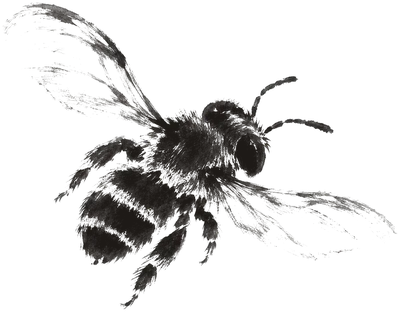
In doña Fidelia May's yard there's a palm-thatched roof, and under it, twenty-two log hives: hollow trunks sealed with clay. Inside lives the xunáan kaab, the «lady bee».
Fictional person
One in five hundred.
kolel kaabIt's also called kolel kaab: kolel means «lady». It doesn't sting. Of roughly 500 stingless bee species, the Melipona was the only one routinely kept.
- Real data · Source: STRI (2005), via ScienceDaily (opens another site)
- Real data · Source: Universidad Autónoma de Campeche (Dialnet) (opens another site)

From a thousand to ninety.
- over 1,0001981
- ~4001990
- 902004
managed colonies in Quintana Roo's Zona Maya: a drop of more than 90%.
In 2005, researchers projected that by 2008 not a single kept hive would be left.
- Real data · Source: Villanueva-Gutiérrez, Roubik & Colli-Ucán 2005, Bee World, via STRI/ScienceDaily (opens another site)
- Real data · Source: Mongabay Latam (2020) (opens another site)
No one to pass it on to.
From 480 to 206 colonies
Source:
across the surveyed apiaries between 2002 and 2011: a third gone in nine years.
According to that study, it wasn't Africanized bees or disturbed forest. What mattered was competition for flowers in large apiaries, and keepers growing old with no one to take over.
«My mother taught me to open the hive slowly, without fear. Now it's Yuridia's turn to learn.»
Fictional personFictional quote
Honey worth its price.
You open the hive, prick the wax pots and the honey drips out slowly. Doña Fidelia sells it by the liter, at a price ordinary honey can't touch.
~MX$1,000 a liter versus ~MX$40
is what Melipona honey fetched compared with common honeybee (Apis) honey, around 2019.
- Real data · Source: Mongabay Latam (2020; first published 2019) (opens another site)
2008 came, and the bees were still here.
155 beekeepers in 60 communities (2011)
Source:
beekeepers in 60 communities (2011)
300 farmers trained at the U Yits Ka'an school (around 2019)
Source:
farmers trained at the U Yits Ka'an school (around 2019)
The forecast didn't come true. Families, farmer schools and researchers brought the practice back. It isn't a relic: it's a craft with apprentices again.
- Real data · Source: Villanueva-Gutiérrez et al. 2013 (opens another site)
- Real data · Source: Mongabay Latam (2020) (opens another site)
«I thought it was a grandma thing. It's biology, and it's ours.»
Fictional personFictional quote

So someone is there to learn.
the next handsMX$1,000 adds a new log hive to a family's meliponary.
Illustrative figure · fictional organization